
Prescribing wheelchair trays: key things to consider
A wheelchair (manual or power) tray may be considered for funding when it is needed to support a person’s functional independence or postural needs. Trays are often customised to suit individual users, which means they are not as easily reissued as other items and can be higher in cost. For this reason, it is important to clearly demonstrate the benefit the tray will provide.
Examples of when a wheelchair tray may be of benefit include:
Postural support of the arm and/or trunk
Independent eating and drinking
Independent communication
Operating a power wheelchair
Examples of customised trays
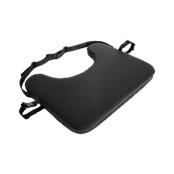
Padded wheelchair tray
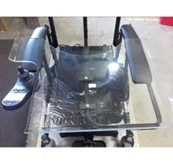
Swing over wheelchair tray
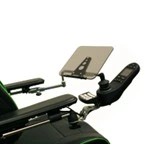
Adjustable wheelchair tray
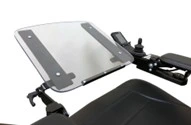
Adjustable wheelchair tray
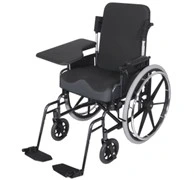
Flip-up half wheelchair tray
Where possible, value for money alternatives, such as an overbed table should be considered first. Tray funding can be considered once the wheelchair has been successfully trialled and shown to meet the person’s needs.
Other helpful points to keep in mind when prescribing wheelchair trays include:
If the person completes transfers independently, it’s important to consider whether the tray can be easily removed and refitted without getting in the way of safe transfers.
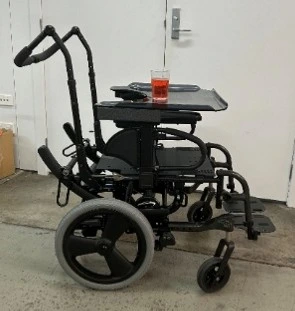
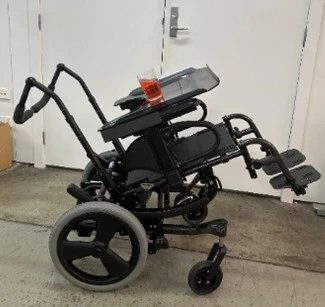
If tilt is needed for postural support, think about how the person will use and benefit from a tray when the wheelchair is tilted, (see images 1 and 2).
Trays should always be prescribed with careful consideration of New Zealand restraint minimisation standards, (Ngā Paerewa Health and Disability Services Standard NZS 8134:2021)
For safety, trays should be removed and securely stored when the wheelchair is used for occupied transport in a vehicle.
It’s also helpful to note that adding a tray may limit the available options for arm support padding.
Wheelchair with no tilt applied
Wheelchair with 45 degrees of tilt applied
When requesting any wheelchair accessory, a clear rationale is required, including how the person will benefit from using the tray and how it will support their needs.
While these guidelines apply in most situations, we recognise that there can be exceptions. Please feel free to contact a Clinical Service Advisor if you’re unsure or would like to discuss a specific situation.
Latest posts
-
Outcome measures for wheelchairs and seating
18 September 2026
-
Physiotherapist checklist for writing strong SRNA-SDA reports for non-List exercise equipment
16 September 2026
-
Functional mobile seating solutions
15 September 2026
-
Impact of power wheelchairs for people with Motor Neurone Disease
11 September 2026
-
MRES updated operational guidelines
1 September 2026